
For automotive & industrial design
VR concept modelling, with the soul of clay.
The clarity of a full-size clay model, at the speed of a digital one. A faster, leaner, cleaner alternative to traditional clay development — without giving up an ounce of craft.
Start a conversationFor a hundred years, automotive design has trusted clay above everything. There is a reason. Clay is the only medium that lets a designer and modeller stand in front of a form at full size, in real light, and resolve it by eye — the way a human will actually meet the finished product. Pixels on a monitor have never been able to tell you whether a surface is right. Your eyes, at one-to-one, in the room, always could.
VR modelling is the first technology to keep that truth and drop the cost. We sculpt at full scale inside a headset, the model rendered in real materials with real reflections, and we shape it directly with our hands. It is digital clay — endlessly malleable, instantly revisable, perfectly data-clean — but judged with exactly the same craftsmanship the clay studio was built on.
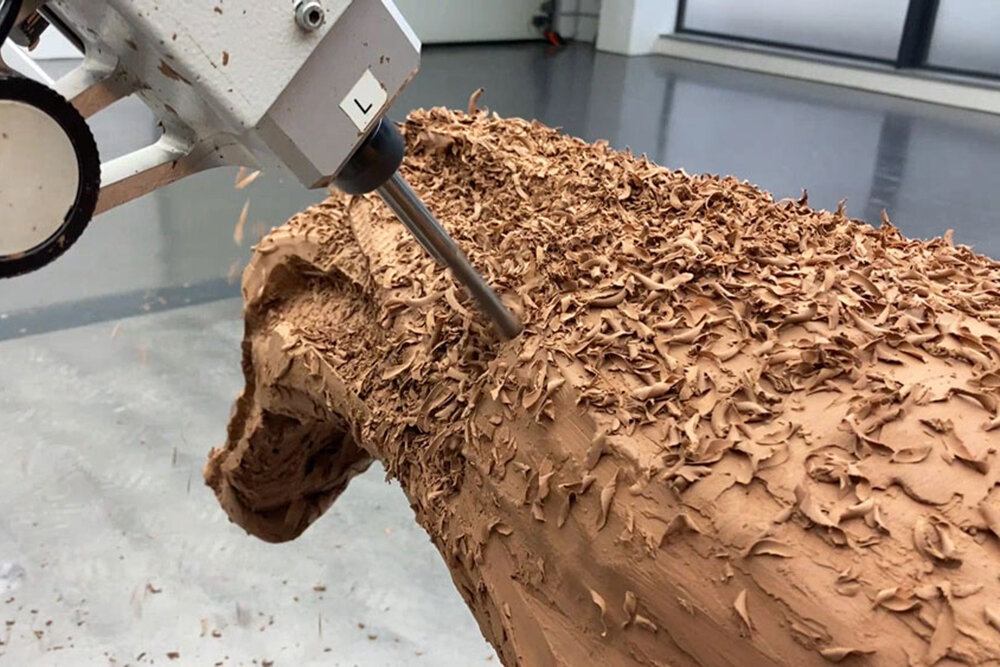
Clay and digital, side by side — the same form, shaped by hand and in the headset.
What clay was really for — and where it now belongs
Clay was never the point. It was the means: a tangible, full-scale stand-in for a product that did not exist yet, made by hand because nothing better existed. It is also slow, costly and messy, and every revision is a physical act measured in days.
Once a headset can project a model into the room that reads as real, clay stops being the place you develop a design and becomes the place you confirm one — for ergonomics, for a final presentation, for the few decisions that genuinely want a physical object. The development itself moves to VR, where iterating is free. The craft doesn't leave. The waste does.
Sub-D is not a sketch tool — it is a surfacing tool
There is a lingering assumption that Sub-D modelling is only good for rough concept blocking. That is a misunderstanding of the medium in skilled hands. The same clay that makes a child's pinch-pot makes a full-size show model; the tool does not set the ceiling, the craftsman does. Sub-D gives a freedom of exploration NURBS cannot, and on a well-built model every control point sits in a deliberate place in the topology, with a deliberate influence on the form.
The result is a highly controlled, highlight-clean surface model that meets the aesthetic and technical brief — and hands downstream Class-A surfacing a vastly clearer starting point, because the form was resolved in three dimensions from the first volume to the last fillet. Not A-class itself. But bloody close, and honest about the difference.
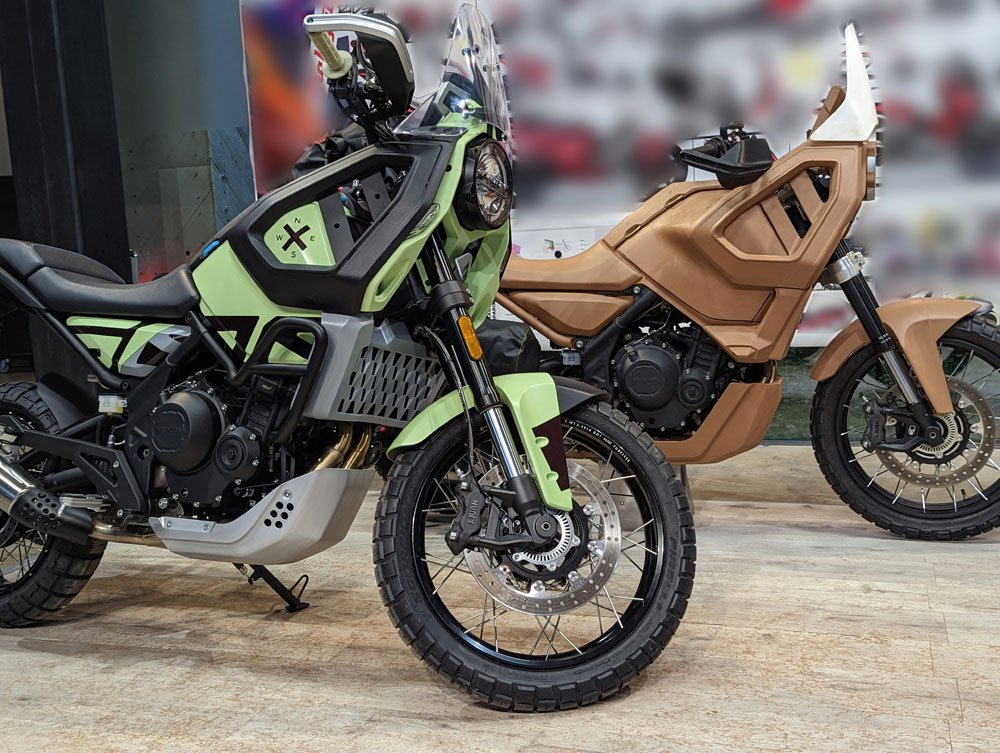
Proof · Brixton Storr 500
The Storr 500 concept that debuted at EICMA was developed exactly this way: laid out to ninety per cent in VR, milled to clay, refined the final ten per cent by hand — with the designer in Austria and the modeller in Germany, working the same model remotely.
Read the Brixton Storr case study →Common questions
-
Is VR modelling a replacement for clay modelling? +
It replaces most of what clay was used for, and keeps clay for what it is still best at. Clay was always a means to an end — the best available way to see and feel a form at full scale in the real world. VR now does that earlier, cheaper and faster, so clay moves from the development medium to a validation and presentation medium. Many programmes still mill one clay near the end; several run with none at all.
-
How does VR clay modelling compare to traditional clay on cost? +
A traditional clay development phase is slow, expensive and messy — armature, material, milling, a studio, and weeks of a skilled modeller’s time per iteration. VR collapses the iteration loop to minutes and removes the physical cost of every revision but the final one. Teams typically see month-long phases compressed to weeks, with a significant, measurable ROI.
-
Can VR surfaces feed a Class-A / production pipeline? +
The Sub-D models are highly controlled and highlight-clean — resolved enough to drive downstream Class-A surfacing in Alias with far less ambiguity than a 2D-derived model, because the form was judged in three dimensions the whole way through. Not A-class itself, but a far better, more complete starting point for it.
-
Does this only work for motorcycles? +
The craft was forged on motorcycles — the most unforgiving sculptural object in transport design — but the principles are universal to any emotional, complex, full-scale form: cars, commercial vehicles, marine, premium consumer products. If it benefits from being judged at human scale, it benefits from VR.
Rethink your clay phase.
Bring a programme to VR and see how much of your timeline — and budget — was being spent on the medium rather than the design.
Start a conversation